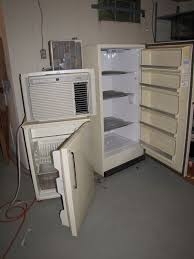
Refrigerators, freezers, air conditioners and dehumidifiers contain CFCs which destroy the ozone layer if it escapes into the atmosphere.
These appliances need to be treated appropriately. They are accepted at the transfer station.
If not taken to the transfer stations, these appliances must be recycled safely at a facility that collects the CFC's for recycling. Go to https://fortress.wa.gov/ecy/recycle/UISearch/ServiceSearch.aspx to find a location near you that recycles them.
Appliances that are not worth repairing can be passed on to scrap metal dealers, usually for free, (once the gas has been removed). Scrap metal dealers accept these products, and many offer free pick-up. The law, in most jurisdictions, requires first, that a certified person removes the coolant and attach an official notice once that has been done. Dealers who sell used fridges and freezers normally have the appropriate certification to remove it, and usually they charge a fee for this service.
Many appliances that are thrown out just need a new wire or a simple adjustment. So, it makes sense to repair them when possible to extend their life.
Do not attempt to remove motor, compressor or tubing from unit yourself.
If the appliance is working, please consider donation.
- Charitable organization may accept large appliances in working condition (but you will have to call ahead to see if they will - not all of them do).
- Or sell or give away on:
Freon, and other chlorofluorocarbons (CFC's) is a family of man-made chemicals which are stable, nonflammable and non-corrosive. Because of their chemical stability, it can take 100 to 150 years for CFC's to break down. Because of the threat to the environment these gases should never be vented or evaporated into the air.
The good news is, recovered CFC gas can be reused in units which require CFC gas. The value of recovered CFC gas is entirely dependent on the purity of the used gas and the current market demand.
Contact the Solid Waste Services for more information