Some municipalities collect leaves and yard trimmings through their curbside collection program (but not always grass clippings), while others allow a drop-off at a Transfer Station depot.
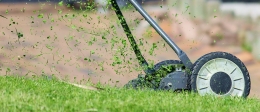
When you mow your lawn, leave the clippings on the grass. For best results, sharpen lawn mower blades regularly, cut the grass when it is dry to prevent clumping of the clippings and cut less than a third of the blade height at a time.
Clippings actually contain the nutrients and mulch to keep lawns healthy. Grass clippings consist of about 4 percent nitrogen, 2 percent potassium and 1 percent phosphorus, which is the same as a bag of fertilizer that read 'Fertilizer 4:2:1'.
Even better for the evironment, reduce the size of your lawn and landscape the rest of your property in natural areas. To keep things looking tidy you can buffer the natural areas from the lawn by cutting an intermediate strip of lawn at the highest mower setting your mower allows. The natural areas of your property create habitat for birds, butterflies and other wildlife.
If you let your lawn grow too long before you cut, and have extra clippings, you can compost them (layered with dry brown materials such as dry leaves for best results).
- Leave clippings on your lawn to decompose naturally (“grasscycling”).
- Add them to a backyard composter
- Make your own backyard composter, or purchase one online or through a local retailer
Missouri publishes an online guide to ecological health care-including how to compost lawn clippings at http://muextension.missouri.edu/explore/agguides/hort/g06958.htm
Another wonderful guide on ecological lawn care comes from Virginia: http://www.ext.vt.edu/pubs/turf/430-402/430-402.html
For more information on composting and grasscycling: http://greenactioncentre.ca/reduce-your-waste/grasscycling/
http://www.thelawninstitute.org/pages/environment/best-management-practices/mowing-grasscycling/