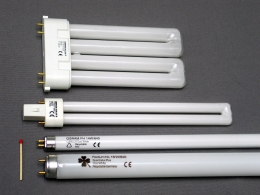
The Light-Cycle Washington program began Jan. 1, 2015, and allows Washington State residents to recycle up to 10 mercury-containing lights at no charge per day by dropping them off at authorized collection sites. The Central Transfer Station, Centralia, and East Lewis County Transfer Station, Morton, are authorized collectors in Lewis County. The main categories of mercury-containing lights accepted by Light-Cycle Washington are compact fluorescent lights (CFLs), fluorescent tubes up to 8 feet long and High Intensity Discharge (HID) lamps. When dropping off more than 10 mercury-containing lights in one day, the first 10 are free and the following rates apply for the remainder:
4 foot straight light -- $0.40 each
8 foot straight light -- $0.80 each
6 foot straight light -- $0.60 each
Compact fluorescent light -- $0.50 each
U-Tube light -- $1.00 each
High intensity discharge light -- $1.00 each
Specialty light -- $2.50 each
They come in two primary types: tube lighting and CFL (compact fluorescent lighting).
Fluorescent lights can range in size from tubes multiple feet long to the compact bulbs that are about the size of a standard lamp light bulb.
Fluorescent tubes and compact fluorescent bulbs contain significant amounts of mercury that can be inhaled or absorbed through the skin. Mercury is a toxic substance harmful to both humans and wildlife. When fluorescent tubes/bulbs are broken (which happens at landfill sites), the mercury contained within is released, creating a risk of exposure to the mercury vapor. Mercury that is exposed to the air can enter the environment and be deposited in lakes and rivers, where it can be transformed into highly toxic methylmercury. Fish and other wildlife can then ingest mercury passing it up the food chain to humans. Once mercury enters the food chain, it is nearly impossible to remove. The United States Environmental Protection Agency estimates that 600 million fluorescent tubes/bulbs are disposed of annually, with over 80% ending up in landfills. Instead of landfilling your lamps, they can now be recycled.
Here you can find retailers who will take it back for recycling: https://www.lightrecycle.org/collection-site-locator/
You need to find a take-back program or drop-off location for recycling these items. Many hardware stores such as Lowes or Home Depot also take unbroken Tubes or CFLs.
Recycled materials that can be recovered from the tubes/bulbs are aluminum, glass, phosphor and nearly pure liquid mercury.
To deal with a broken fluorescent light:
Open the windows and leave the room for 15 minutes.
Return to the room with a plastic ziplock bag, tape and a wet sponge
Use the tape to pick up the broken pieces. Place the broken pieces in the bag.
Use more tape to pickup the dust. Do not use a vacuum. Place the tape in the bag.
Use a wet sponge to clean the area. Place the sponge in a bag.
Take the bags to the Hazo Hut for proper disposal. See the Hazo Hut pages for hours and location.
For more information call the Hazardous Waste Program Coordinator at 360-740-1221.